

Understanding Laundry Symbols: A Global Perspective on Care Labels
- Legislation
- Symbols
Confused by clothing care labels? This guide clarifies the key differences between textile care symbols used in the USA (ASTM standards) and the internationally recognized ISO/Ginetex system. Understand washing, bleaching, drying, and ironing symbols globally to properly care for your garments.
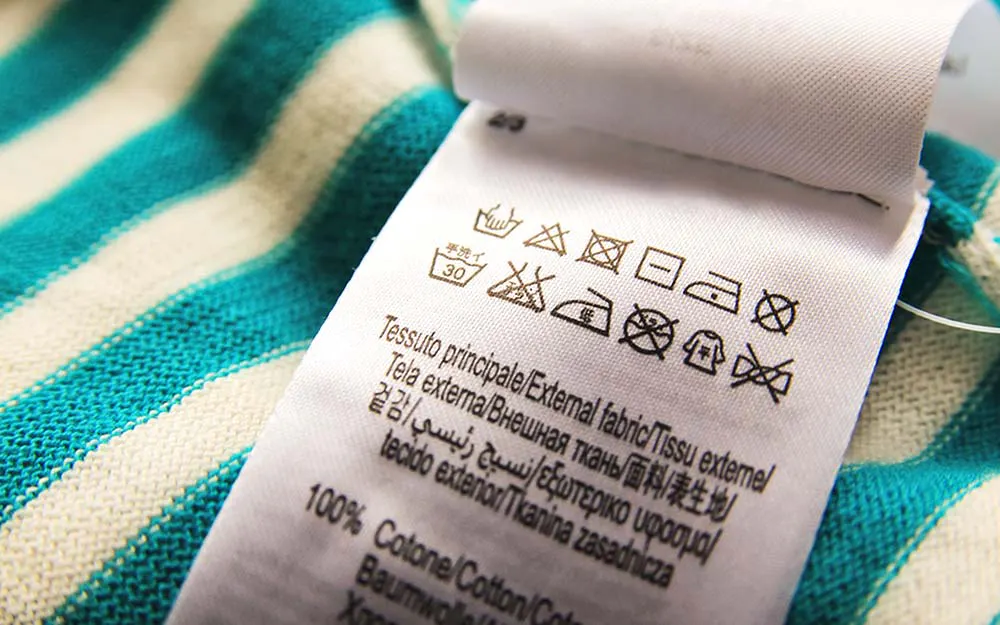
One of the most important pieces of information on care labels for consumers concerns cleansing and care instructions, represented by laundry symbols indicating domestic treatment processes for the apparel good. These include washing, bleaching, drying (tumble or natural), ironing, and professional textile care.
Understanding the symbols present on care labels is fundamental for better garment care, extending their lifespan and preventing damage. Misinterpreting care instructions can lead to garment shrinkage, fading, color migration, etc.
Globally, the ISO 3758 standard is widely adopted for standardizing care processes and their symbols/descriptions on care labels. This standard is used by numerous countries around the world, including those in Europe and many in Latin America, through the Ginetex model.
While consumers often purchase and import goods from various nations that use the same symbol system, some significant players in the global economy utilize symbols from other standards, such as the United States, which follows the ASTM D5489 standard. This standard varies in some information and symbols from the ISO standard. Therefore, whether you are importing a garment as an individual or exporting a batch as a business, it's important to know the symbols used and ensure they comply with local regulations.
Continue reading to understand the differences in symbols between the ISO and ASTM standards.
Care & cleansing instructions
Washing (Wash)
For washing symbols, both standards use the tub (a bucket with water) and its variations based on temperature, washing process, hand washing, etc.
The first difference lies in the drawing of the tub itself: ISO symbols depict water waves as curved lines, while ASTM symbols use angled waves with straight edges. Despite their similarity, it's incorrect to use the angled wave design in countries that follow the ISO standard, as it is not recognized.
In the United States, the hand wash symbol is also different: the hand, instead of being centered with fingers pointing downwards as in the ISO standard, is positioned in the upper right corner, facing diagonally. Additionally, the hand is filled in black, contrasting with the outline, whereas in ISO, the hand only has an outline.
Finally, the "gentle" and "very gentle" processes are not directly translated into these terms in English. The bars below the tub represent "permanent press" (one bar) and "delicate/gentle" (two bars). ASTM standards require wash temperatures to be represented in degrees Celsius and by dots.
Bleaching (Bleach)
For the bleaching symbol, represented by a triangle, there is primarily one difference: to indicate the prohibition of any type of bleaching, the ISO symbol uses an outlined triangle with an X through it, while the ASTM symbol uses a solid black triangle (similar to the hand in the wash symbol) with an X through it.
Tumble Drying (Dry)
In the United States, drying garments and other textiles is predominantly done using dryers, a process technically termed "tumble drying." This is partly because in some regions, natural drying on a clothesline is restricted, leading to movements like "right-to-dry," advocating for residents' right to dry clothes outdoors. Consequently, machine drying is often more common than natural drying. Let's examine the differences in symbols below.
The symbol for tumble drying is the same in both standards: a circle inscribed in a square, with variations regarding the maximum temperature to be used in the machine and the drying processes, as seen with the washing symbols.
ISO symbols indicate two possible tumble drying temperatures: a maximum of 60°C represented by one dot in the center, and a maximum of 80°C represented by two dots in the center. In the United States, this temperature scale is not explicitly in degrees Celsius but rather by the dryer setting itself: high, medium, and low.
Three dots in the center of the circle represent that a high temperature can be used, an indication that doesn't exist in the ISO standard in the same way. Additionally, there are categories "any heat," represented by an empty circle, and "no heat/air," represented by a solid black circle, for not using heat in the dryer. The "no heat/air" setting should not be confused with the symbol for "do not tumble dry," as they are different symbols.
Tumble drying also has different processes represented by a bar below the symbol: one bar is permanent press, two bars are delicate/gentle.
Natural Drying (Dry)
As explained earlier, tumble drying is more common in the United States than in many other parts of the world where air drying on clotheslines is prevalent. However, both standards include symbols for natural drying, both vertically and horizontally, with some differences.
ISO symbols indicate natural drying in different ways: horizontal drying by a horizontal line, line drying by a vertical line, drip drying in either position by two lines, and drying in the shade by a small diagonal line in the upper left corner. These instructions exist in the ASTM standard but are represented differently.
For line dry, the symbol is a square with a curved line at the top, symbolizing a clothesline. Dry flat has the same representation. The indication for drip drying does not specify whether it's on a line or flat and is simply called "drip dry," represented by three vertical lines.
Drying in the shade has two diagonal lines in the upper left corner instead of one. There is also another symbol for the drying process that does not appear in the ISO standard: the "do not wring" symbol is a drawing of a garment being twisted with an X over it, indicating that wringing is not allowed.
Ironing (Iron)
The ironing symbols on care labels are quite similar between the two standards, with some differences in the drawing and the existence of another symbol within the ASTM standard.
Starting with the drawing, the iron in the ISO standard is made with straight lines on all sides, while in the ASTM standard, the left side of the iron has a slight curve. Again, these are minor details that may not be noticed by the manufacturer or the consumer; however, if a garment sold in a country using the ISO standard has this symbol, the distributor may face penalties.
A particularity of ironing in the ASTM symbol system is the presence of a symbol to indicate not to use steam: within the same drawing of the iron, two lines can be added below, as if representing steam, with an X over them. In the ISO symbol system, if the symbol has only one dot inside, it means the maximum temperature of the iron's soleplate is 110°C, and steam should not be used, as it can cause irreversible damage to the garment.
Professional Textile Care (Dryclean)
For professional textile care, we separate it into two categories: dry cleaning and wet cleaning, each with its respective and appropriate letters inside a circle. In the ISO standard, dry cleaning can be represented by the letter P, allowing the use of perchloroethylene and solvents listed under the letter F, or by the letter F, allowing the use of hydrocarbon solvents.
The ASTM symbol system uses the same letters and an additional one, the letter A, allowing any type of solvent for cleaning; however, the letters have slightly different descriptions. The letter P indicates that any solvent is permitted except trichloroethylene, and the letter F indicates that only petroleum solvents can be used, which means the same as only hydrocarbon solvents.
Furthermore, the bars below the symbol indicating a gentle process, as in the ISO standard, do not exist. Instead, they are replaced by four lines surrounding the circle in four corners, which can indicate a short wash cycle, low temperature, no steam finishing, or reduced moisture.
For wet cleaning, the letter W remains the same for the processes.
Additional Notes
Similar to the ISO symbol system, it is possible to add notes for extra instructions in addition to just using the symbols.
Care labels in the United States are known for having care and conservation information written out in text rather than relying solely on symbols. Therefore, it is more common to find a North American garment label with text instructions than just symbols.
Did you like it? Share!